Your Dependencies Have Dependencies (And So Do Theirs)
I was reviewing a security audit last week when I noticed something that made me pause my coffee mid-sip. A React application with 47 direct dependencies had somehow accumulated 2,847 transitive dependencies. That’s a 60-to-1 multiplier. Each one of those packages is a potential attack vector, a maintenance burden, and a delightful little time bomb that could detonate when you least expect it.
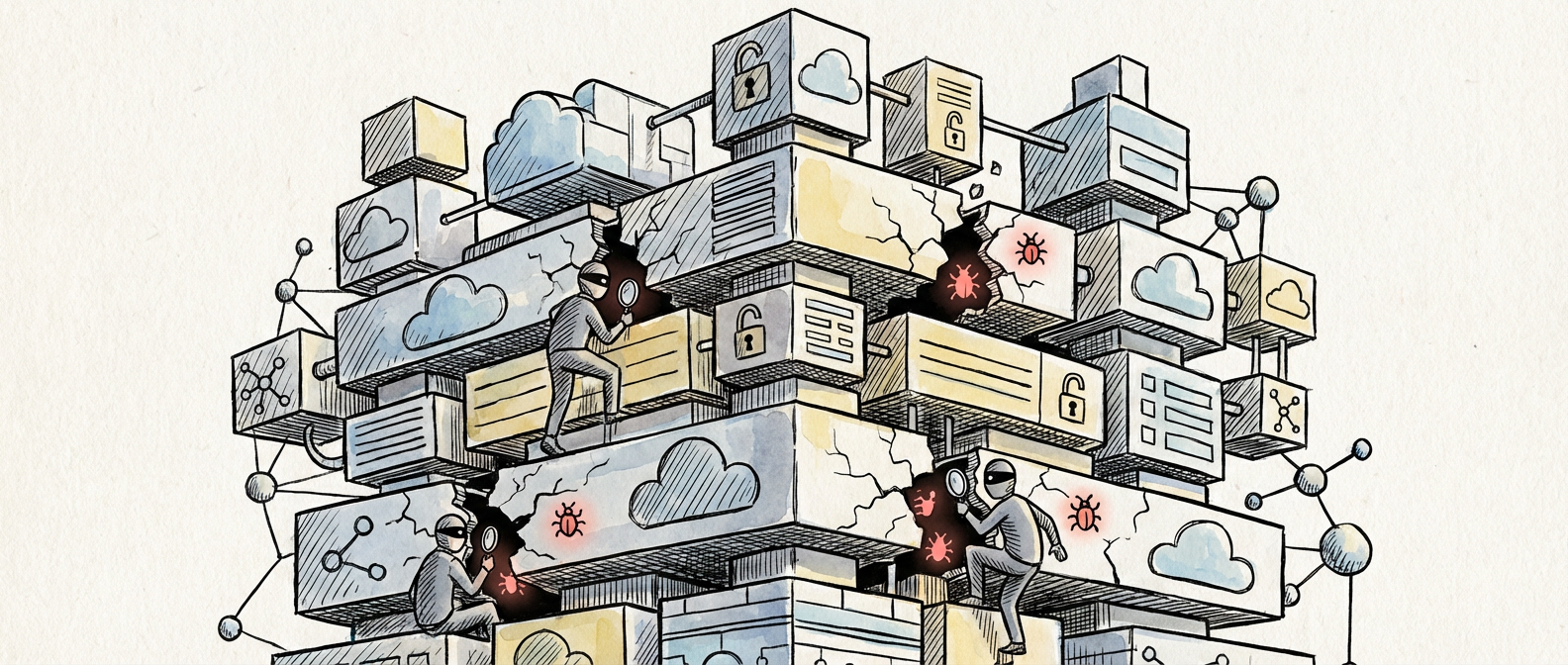
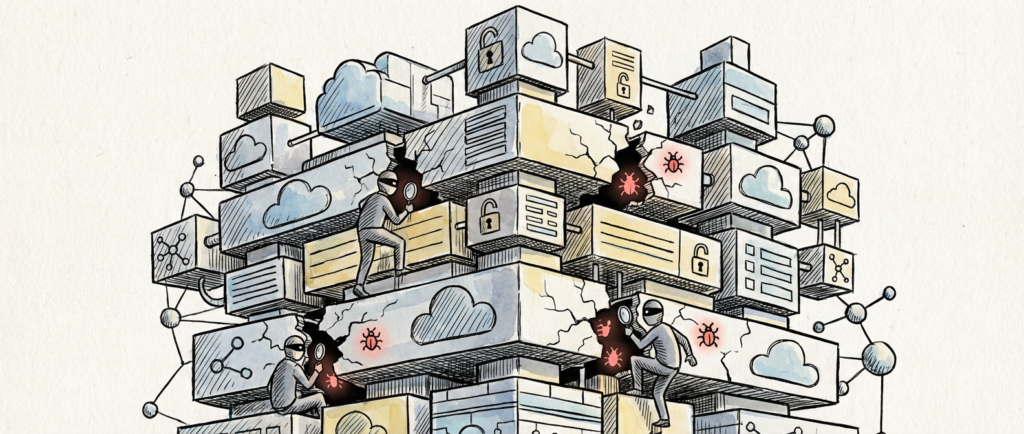
The modern JavaScript ecosystem has embraced the Unix philosophy with religious fervor. Do one thing well, they say. Compose solutions from small, focused modules. It sounds elegant until you realize that displaying “Hello World” now requires downloading half the internet. The left-pad incident wasn’t an anomaly. It was a preview of what happens when we build cathedrals on foundations made of Jenga blocks.
What troubles me isn’t the dependency count itself. It’s the collective shrug we’ve given to the security implications. We’ve normalized the idea that our applications should depend on thousands of packages maintained by strangers, updated constantly, and governed by nothing more substantial than semantic versioning and good intentions. The attack surface area has grown exponentially, but our security practices still assume we’re dealing with monolithic applications written by people in the same building.

Container Images Are Not Security Boundaries
Docker revolutionized deployment, but it also gave us the world’s most sophisticated method of shipping vulnerabilities directly to production. I’ve seen container images that started as 50MB Alpine Linux bases and somehow ballooned to 2GB monsters containing entire Linux distributions, multiple language runtimes, and enough outdated libraries to make a penetration tester weep with joy.
Here’s the fundamental misconception: treating containers as security isolation mechanisms. They’re not. They’re process isolation mechanisms with a thin layer of resource controls. The kernel is still shared. The network stack is still accessible. That shiny container orchestration platform you’re running? It has root access to every node, and if it gets compromised, your “isolated” workloads are about as secure as files in a shared folder.
Multi-stage builds were supposed to solve the bloat problem, but most teams use them wrong. They’ll copy their entire application source code into the build stage, install dependencies with package managers that cache everything, then selectively copy artifacts to the runtime stage while leaving behind manifests that still reference the vulnerable packages they “removed.” The result is smaller images with identical attack surfaces and worse debugging capabilities.
The solution isn’t more complex tooling. It’s going back to first principles. Minimal base images. Explicit dependency management. Regular vulnerability scanning that actually fails builds instead of generating reports that nobody reads. And please, for the love of all that is debuggable, stop running everything as root inside containers just because you can.
API Security Theater and the JWT Cargo Cult
JSON Web Tokens have become the hammer that makes every authentication problem look like a nail. Teams implement JWT-based authentication with the same enthusiasm they once reserved for microservices, usually with about the same level of understanding of the underlying complexity. The result is an ecosystem full of APIs that are simultaneously over-engineered and fundamentally insecure.
The most common mistake is treating JWTs as magic security tokens instead of what they actually are: a standardized way to encode claims that can be verified without a database lookup. Teams store sensitive data in JWT payloads, forget that the signature only prevents tampering (not reading), and implement custom verification logic that bypasses critical security checks. I’ve seen production systems that validate JWT signatures but ignore expiration times, accept tokens signed with “none” algorithms, and trust client-provided key identifiers without verification.
Rate limiting deserves special mention as the poster child for security theater. Most implementations are laughably easy to bypass. IP-based rate limiting gets defeated by proxy rotation. User-based rate limiting assumes you can identify users before they authenticate. API key-based limiting creates a single point of failure. The sophisticated attackers aren’t brute-forcing your login endpoints. They’re exploiting the business logic flaws in your password reset flows, account creation processes, and state management.
Real API security requires understanding your threat model, not copying patterns from blog posts. Authentication should happen once and be cached appropriately. Authorization should be centralized and consistently applied. Input validation should happen at the boundary, not scattered throughout your codebase. And for the record, CORS is not a security feature. It’s a browser convenience that does nothing to protect your API from server-side attacks.
The Infrastructure as Code Blindspot
Infrastructure as Code promised to bring software engineering practices to operations. What we got instead was YAML files with root-level privileges and the operational complexity of distributed systems applied to what used to be relatively simple deployment scripts. Terraform configurations have become multi-thousand-line monstrosities that nobody fully understands, managed by CI/CD pipelines with administrative access to cloud accounts worth millions of dollars.
The security implications are staggering. Cloud credentials with broad permissions get embedded in environment variables, stored in version control, and passed through build systems that log everything. State files containing sensitive configuration data get stored in S3 buckets with public read access. Terraform providers auto-approve resource changes that could expose entire network segments to the internet.
The abstraction layers haven’t helped. Kubernetes operators that manage infrastructure resources create a meta-infrastructure problem where your infrastructure definition depends on cluster state, which depends on container images, which depend on base images with their own vulnerabilities. When something goes wrong (and something always goes wrong), the debugging process requires understanding multiple abstraction layers, each with their own failure modes and security implications.
Cloud-native security tools promise to solve these problems with more automation, more scanning, and more alerts. But automation without understanding is just faster ways to make mistakes at scale. The real solution is boring: principle of least privilege, regular credential rotation, comprehensive audit logging, and humans who understand what their infrastructure actually does instead of treating it as a black box that occasionally needs YAML adjustments.
Building Systems That Fail Securely
Security vulnerabilities aren’t bugs. They’re design failures. They happen when systems behave in ways that benefit attackers instead of failing safely. The path forward isn’t more security tools or frameworks. It’s building systems with security as a fundamental design constraint, not an afterthought to be bolted on later.
This means designing APIs that fail closed instead of open. It means choosing boring, well-understood technologies over exciting new frameworks that haven’t been battle-tested. It means accepting that security often conflicts with convenience and choosing security anyway. Most importantly, it means recognizing that every dependency, every abstraction layer, and every piece of infrastructure increases complexity in ways that tools can’t automatically manage.
I’ve spent enough time debugging production incidents to know that the systems that survive are the ones designed by people who assume everything will eventually break. What specific approaches have worked (or failed spectacularly) in your experience? The comment section exists for a reason, and I’m particularly interested in hearing about the subtle vulnerabilities that only emerge under production load.