
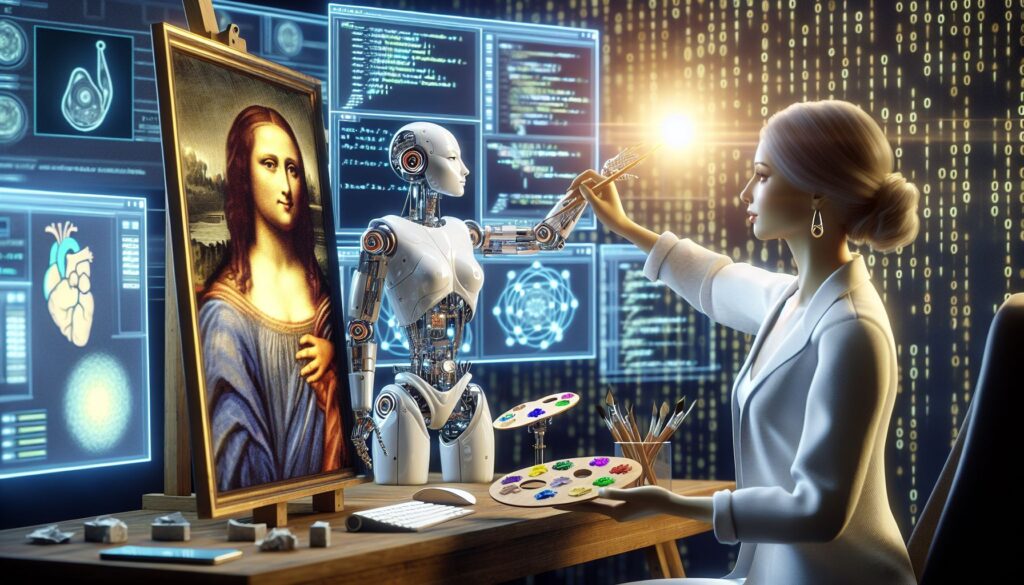
Hey tech-savvy explorers! Let’s talk about one of my favorite places where technology crashes: the art scene. That’s right, I’m talking about Artificial Intelligence getting a canvas. And spoiler alert—it’s wildly fun and even a little mind-boggling.
Imagine years ago, when your software dreams consisted of sticking a floppy disk into a chunky computer to draw pixelated masterpieces on MS Paint. Now, fast forward to machine learning models that can craft fine art reminiscent of Da Vinci, compose melodies that channel Beethoven, and write sonnets Shakespeare would envy. Welcome to AI in Creative Arts—a growing tech space where creativity knows no bounds.
The Dawn of Machine Muse
Artificial Intelligence in the arts isn’t just a quirky novelty; it’s a game-changer. We’ve already seen AI go beyond mere technical applications. Remember those days when creating a chatbot that could hold basic conversations was mind-blowing? Now, AI is not just about mimicking human logic; it’s learning to express what we call creativity.
Creating the Canvas: The Rise of AI Artists
Smart companies and researchers are using deep learning algorithms to do everything from generating original visual art to crafting new literary works. One prominent example is OpenAI’s DALL-E, which can generate detailed images from text descriptions. Want to see what a space-faring dinosaur looks like, painted in a Cubist style? Easy. DALL-E’s got you covered!
On the musical front, look no further than AIVA (Artificial Intelligence Virtual Artist), which is composing classical music. I can barely whistle Beethoven’s symphonies from memory, but AIVA composes complex orchestral music by understanding music theory better than quite a few people.
The Beautiful Chaos: AI’s Creative Footprint
Pop quiz! What do you get when a neural network looks at thousands of impressions of, let’s say, a tomato? You get a delightfully confused watermelon-with-wings sort of art. While amusing at times, AI’s artistry isn’t just random. The surprisingly harmonious blend of strategy and chaos is an artistic philosophy in the best sense.
The Big Question: Is It Art if a Robot Makes It?
Now, some of you might say, “Isn’t art supposed to be an inherently human experience?” You’ve got a point, and philosophers and critics are wrestling with this big time. We’re questioning the essence of creativity, individual expression, and emotional connection—while sipping our double-shot espressos, of course. But AI in art forces us to rethink both the definition and ownership of creativity.
One artist I met at a tech convention told me AI didn’t threaten her work but brought a fresh perspective to it. She compared AI to a curious, playful partner who challenges her predictable patterns and reignites her creative spark. Was it Picasso or AI who said, “Learn the rules like a pro, so you can break them like an artist”?
Artistic Implications & Future Prospects
AI isn’t just a player in the background; it’s daring to rewrite creatives’ playbooks on a grand scale. From democratizing access to art tools to personalizing content curation, creativity is not the privilege of artistic elites anymore.
Democratizing Creativity
AI is changing access and creating entry points for new artists who might not have the resources to attend elite art schools. Platforms that use AI are providing a launchpad for beginners, offering toolkits once reserved for skilled professionals. It’s like giving a brush to everyone in the village and gently inviting them to paint their vision. A color revolution is happening!
The Art of Curation & Personalized Experiences
With sophisticated AI curation, gone are the days of digging through endless galleries to find something that piques your fancy. AI can learn about your tastes faster than your partner remembers your anniversary. This means more personalized experiences that will leave art connoisseurs delighted and satisfied.
Plus, imagine entertainment tailored to your mood. AI predicts what type of music will hit you just right at the end of a tough day, or at the start of an exciting one. The audience-led revolution is both thrilling and a bit scary; it’s like Netflix recommending a tear-jerker just when you need a good cry.
The Road Ahead
The way forward isn’t without road bumps. AI still struggles with understanding subtleties like humor, irony, and context. (It won’t likely be performing stand-up comedy soon!) And ethical concerns of bias, copyright, and creative ownership persist. But honestly, how boring would innovation be without a few challenges?
Basically, AI is the new player in the worlds of brushstrokes and lyrics. It’s welcoming us into an expanding universe where limits are meant to be poked, prodded, and redesigned altogether.
So, my prediction? We’re just scratching the surface of AI in the creative arts. Keep your eyes peeled. Our software-based Picasso may one day replace my scribbled notes on this blog with something far more profound. And you know what? I’m excited to see where this wild canvas of future creativity takes us.