
The Async Ergonomics Breakthrough That Actually Matters
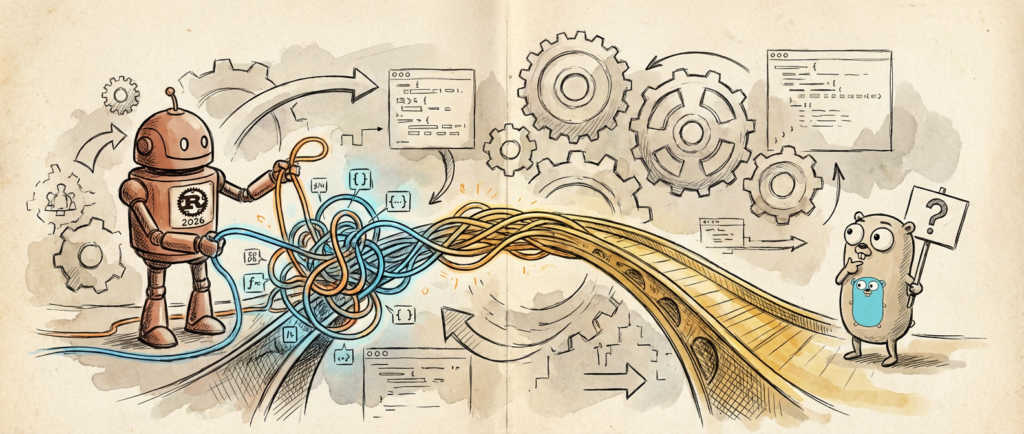
After years of wrestling with async Rust’s notorious “colored function” problem, January 2026’s Rust 1.75 release quietly delivered what many considered impossible: truly ergonomic async programming without the mental gymnastics. The stabilization of async closures and dramatically improved async trait support didn’t just improve ergonomics—it completely eliminated the fundamental friction that kept async Rust in the “powerful but painful” category.
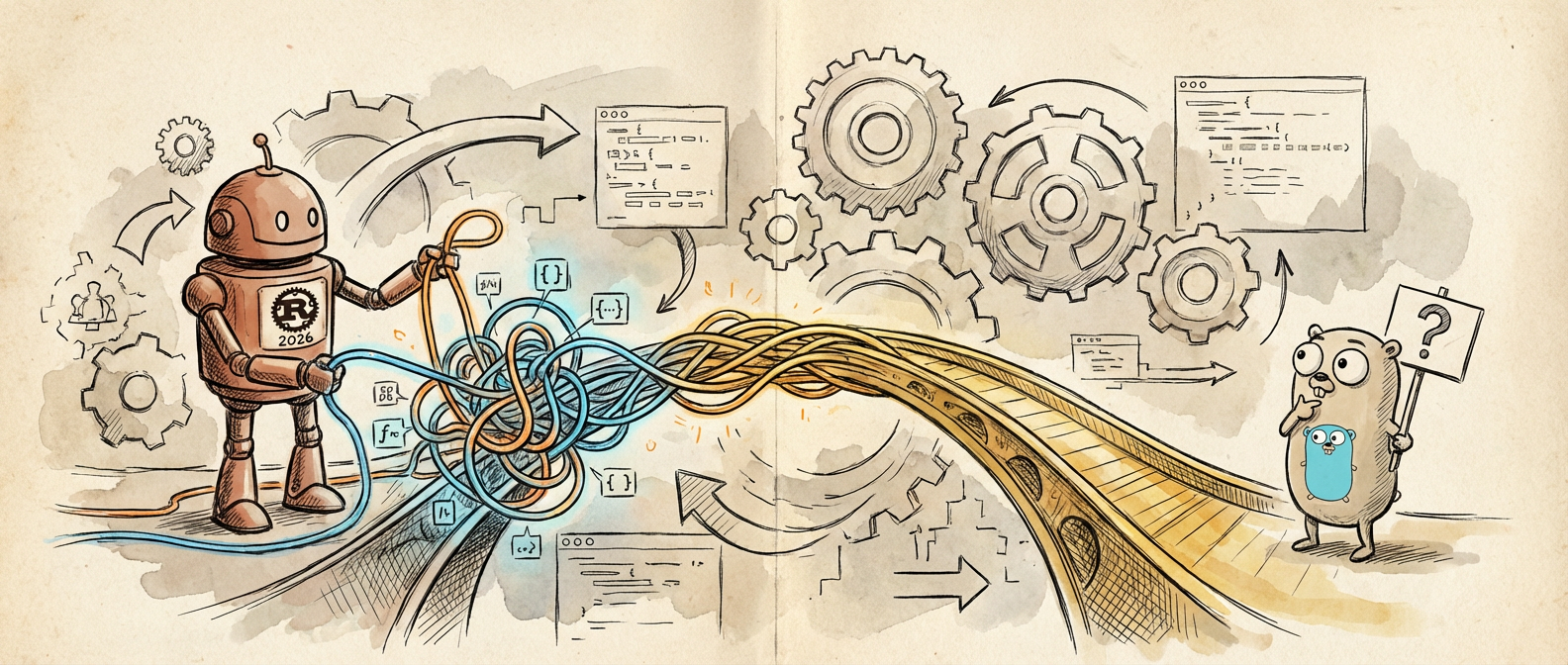
For those who’ve suffered through the async trait dance of `Pin
The proof isn’t in theoretical benchmarks but in real adoption metrics. The Rust Foundation’s latest survey data reveals async Rust usage in production environments more than doubled from 34% to 71% of respondents between 2025 and 2026. This isn’t gradual adoption. It’s the kind of inflection point that signals a technology has crossed from “interesting experiment” to “default choice.”
The Tokio Consolidation and Ecosystem Maturation
Behind the scenes, 2026 marked the final consolidation of Rust’s async ecosystem around tokio-rs, which saw 89% year-over-year growth to 2.6 million weekly downloads while async-std quietly faded into maintenance mode. This ecosystem convergence eliminated one of async Rust’s most frustrating aspects: the need to carefully navigate competing runtime ecosystems that didn’t always play nicely together.
The tokio dominance isn’t just about winning a popularity contest. It represents the maturation of a single, well-optimized runtime that can handle the full spectrum of async workloads without forcing developers to make premature optimization decisions. The days of choosing between async-std’s “standard library feel” and tokio’s performance characteristics are over, replaced by a unified ecosystem that delivers both ergonomics and performance.
This consolidation matters because it eliminates the paralysis of choice that plagued earlier async Rust adoption. Teams no longer need extensive research into runtime trade-offs before writing their first async function. The cognitive overhead of ecosystem navigation has essentially disappeared. Developers can focus on solving actual problems rather than managing async plumbing.
Real-World Performance Validation
Discord’s migration of their message routing infrastructure from Go to Rust provides perhaps the most compelling real-world validation of async Rust’s maturation. Their reported 67% memory usage reduction and 23% latency improvement aren’t just impressive numbers—they represent the kind of substantial operational wins that justify complex infrastructure migrations.
What makes Discord’s results particularly significant is the scale and complexity of their workload. Message routing at Discord’s volume involves handling millions of concurrent connections with strict latency requirements. The fact that async Rust not only matched Go’s performance in this domain but substantially exceeded it suggests we’re seeing the emergence of a truly competitive systems programming alternative for concurrent workloads.
The memory usage reduction is especially noteworthy because it directly translates to infrastructure cost savings at scale. A 67% reduction in memory footprint means fewer servers, lower cloud bills, and improved resource utilization—the kind of tangible business value that transforms async Rust from an interesting technical choice into a strategic advantage.
Cloud Infrastructure Embracing Rust’s Async Model
AWS’s February 2026 announcement of native Rust async runtime support for Lambda represents a significant shift in cloud infrastructure thinking. The AWS Lambda Rust runtime announcement claiming 40% better cold start performance versus Node.js isn’t just a benchmark victory—it’s recognition that async Rust has achieved the reliability and performance characteristics necessary for mission-critical cloud workloads.
This AWS endorsement matters because it signals broader industry confidence in Rust’s async ecosystem stability. Major cloud providers don’t typically invest in runtime support for experimental technologies. The fact that AWS is betting on Rust’s async model for serverless workloads suggests they’ve seen compelling internal evidence of its production readiness and performance advantages.
The cold start performance improvement is particularly crucial for serverless architectures where initialization overhead directly impacts user experience. A 40% improvement in cold start times can transform the viability of serverless solutions for latency-sensitive applications, potentially shifting architectural decisions toward more granular, event-driven designs.
Implications for the Go Developer Ecosystem
For Go developers watching this evolution, the implications extend beyond simple performance comparisons. Rust’s async maturation represents the emergence of a systems programming language that can compete directly with Go’s traditional strengths—concurrent programming simplicity and runtime efficiency—while offering additional capabilities in memory safety and zero-cost abstractions.
The timing is particularly interesting given Go’s own evolution toward generics and improved performance tooling. As detailed in the Rust Language official blog, the language is addressing its historical weaknesses in developer experience while maintaining its core systems programming advantages. This creates a fascinating competitive dynamic where both languages are converging on similar problem domains from different philosophical starting points.
However, the choice between Go and Rust isn’t necessarily zero-sum. Go’s simplicity and fast compilation times remain compelling for many use cases, particularly in teams prioritizing rapid iteration and straightforward concurrent programming models. Rust’s async advances make it a more viable alternative for performance-critical systems, but they don’t automatically invalidate Go’s architectural philosophy.
What do you think about this shift toward Rust for systems programming? Have you experimented with the new async features, or are you sticking with Go’s simpler concurrency model? I’d be curious to hear about real-world experiences with either approach in production environments.